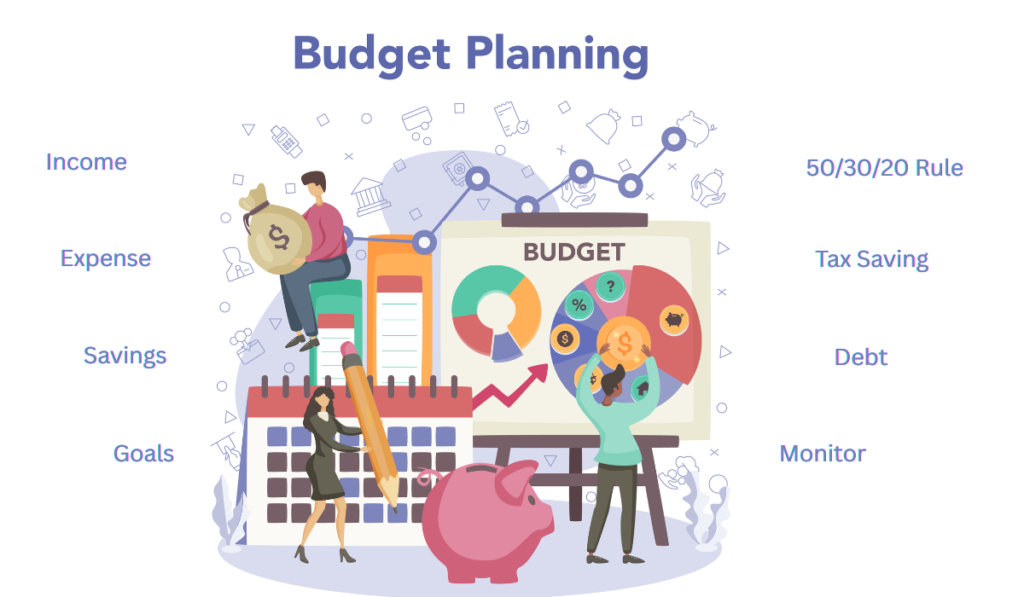
Effective budgeting strategies help you control spending, save more, and achieve financial goals. Effective monthly budgeting can control your expenses like groceries, school fees and festivals, ensuring savings grow despite inflation. Track your income and spending to allocate every rupee wisely using proven rules.
Start your effective budgeting in below 10 simple steps:
1. Create a Monthly Budget: Take Control of Your Salary
Managing your money starts with one simple but powerful habit and that is creating a monthly budget. Without a proper plan in place, salary tends to disappear before the month ends.
Firstly, your monthly budget should start by noting your actual in-hand income after all deductions. In addition, your income may include any freelancing income as well. Knowing your exact monthly inflow helps you make realistic spending plans.
Secondly, list all your expenses based on categories like fixed and variable. Fixed expenses include rent, EMI, insurance premium, utility bills while variable includes food, groceries, transportation, subscriptions, and other spendings.
You may use a simple spreadsheet or a budgeting app or physical notepad to record each expense.
2. Follow the 50/30/20 Rule: Effective Budgeting Strategy
The 50/30/20 rule is a simple way to manage your monthly salary after tax and other deductions. It says put 50% on your needs, 30% on wants while remaining 20% on savings and investment.
Your 50% covers must-have expenses like rent, EMI, insurance premium, groceries, transportation and electricity bills.
Your 30% shall go towards things like eating out, movies, shopping, or subscriptions. These are the things that you want as per your lifestyle but can be avoided if situation arises.
Rest 20% shall go into combination of emergency fund, investments, or extra debt payments. Keep as much as possible portion of this a automated like contribution towards emergency fund or investment SIP.
For example, from your in-hand income of ₹60,000 – keep ₹30,000 for your needs, ₹18,000 for your want and remaining ₹12,000 for savings and investment.
3. Consult Your Budget Before Every Financial Decision
Checking your budget before making additional expenses beyond monthly budget is important to maintain financial stability and avoid debt. It helps you understand if you have enough money left after covering your essential needs and savings goals. By reviewing your budget, you can decide wisely whether an extra expense fits into your financial plan or requires you to cut back elsewhere.
4. Look for the Best Deals: Save on Major Purchases
Before making any big buys, look for best deals which can help you save thousands of rupees without cutting quality. Smart shopping during festive season turns expensive items into bargains and can fit well in your budget. Compare prices on multiple digital platforms before buying. Use bank offers and promotions for extra savings.
5. Set Clear Goals: Align Your Salary with Your Ambitions
Setting clear financial goals helps you match your salary with what you truly want to achieve in life. When goals are specific and realistic, you can plan better and stay motivated to save and invest wisely.
Knowing your monthly salary is key to creating a budget that supports your goals. If your goals require more savings, consider increasing income through freelancing or reducing expenses.
Break your goals based on duration like short-term for up to 3 years, medium-term for 3 to 7 years, and long-term for over 7 years. This helps you invest in the right instruments suited to each goal’s duration, balancing risk and returns.
As life changes at every moment, review your goals and budget every year. Adjust savings and investments accordingly to stay on track.
6. Use Your Credit Card Smartly: Avoid Falling into Debt
Using a credit card smartly can help you build a strong credit score and enjoy rewards, but careless use can quickly trap you in high-interest debt. Always remember that credit cards are not extra income; they are short-term loans you must repay on time.
Golden rule for credit card spending is use the card for an amount that you can fully repay by the due date from your next salary. Always pay the full amount due and not just the minimum, to avoid interest and late fees.
Avoid withdrawing cash from credit cards as cash advances attract extra charges and interest from day one. Use credit card for monthly planned expenses in your budget, just to enjoy rewards, cashback and extra security.
7. Maximize Your Tax Savings: Keep More of Your Earnings
Maximize your tax savings by paying less tax legally so you get to keep more of your hard-earned money. In India, investment in Public Provident Fund (PPF), Employee Provident Fund (EPF), Equity Linked Saving Scheme (ELSS), National Saving Certificate (NSC) can save up to ₹1.5 lakh per year under Section 80C.
You can claim deductions for health insurance premiums and home loan principal repayment and interest payments as well.
8. Build an Emergency Fund: Prepare for Uncertainty
An emergency fund can help you in situation ike job loss, medical bills or family crises. Always keep emergency fund equivalent to your 3 to 6 month expenses. Do not put this emergency fund in high risk or high volatility assets. Always park your emergency fund into saving account or liquid fund which give you high liquidity whenever needed.
If you are still building your emergency fund then automate this transfer from salary to separate account on payday.
9. Monitor Your Financial Progress: Adjust to Stay on Track
Regularly check if your spending, savings and investments match your goals, and tweak them if needed. Monthly or quarterly reviews help you in identifying the issues early and can be adjusted before debt hits. Involve your companion (spouse) in your reviews, share progress with them and have both accountability of it.
10. Increase Your Earnings: Explore Additional Streams of Revenue
Increasing your earnings through side hustles lets you beat inflation, build savings faster, and fund dreams like a home or child’s education. With cost of living rising every day, your single salary often falls short in metro cities like Mumbai or Delhi. Additional income over your monthly salary fills emergency funds, clears debts, and boosts investments.